Attractiveness Test
A proportion and symmetry breakdown of your face, explained in plain terms, not a verdict on your worth.
What the Facial Harmony Test does
This attractiveness test looks at the geometry of a face rather than handing out a single pass or fail grade. Upload a clear photo and the tool measures things classical artists and modern researchers both study: how closely the two halves of your face match, how your features sit against the thirds and fifths guidelines, and how your jaw, cheekbones and eyes relate to each other in scale. You get a short written readout plus a few named scores. It works best as a curiosity exercise or a way to understand your own proportions before a haircut or photo shoot, not as a ranking against anyone else. Symmetry and proportion are only part of what makes a face memorable.
See a sample result
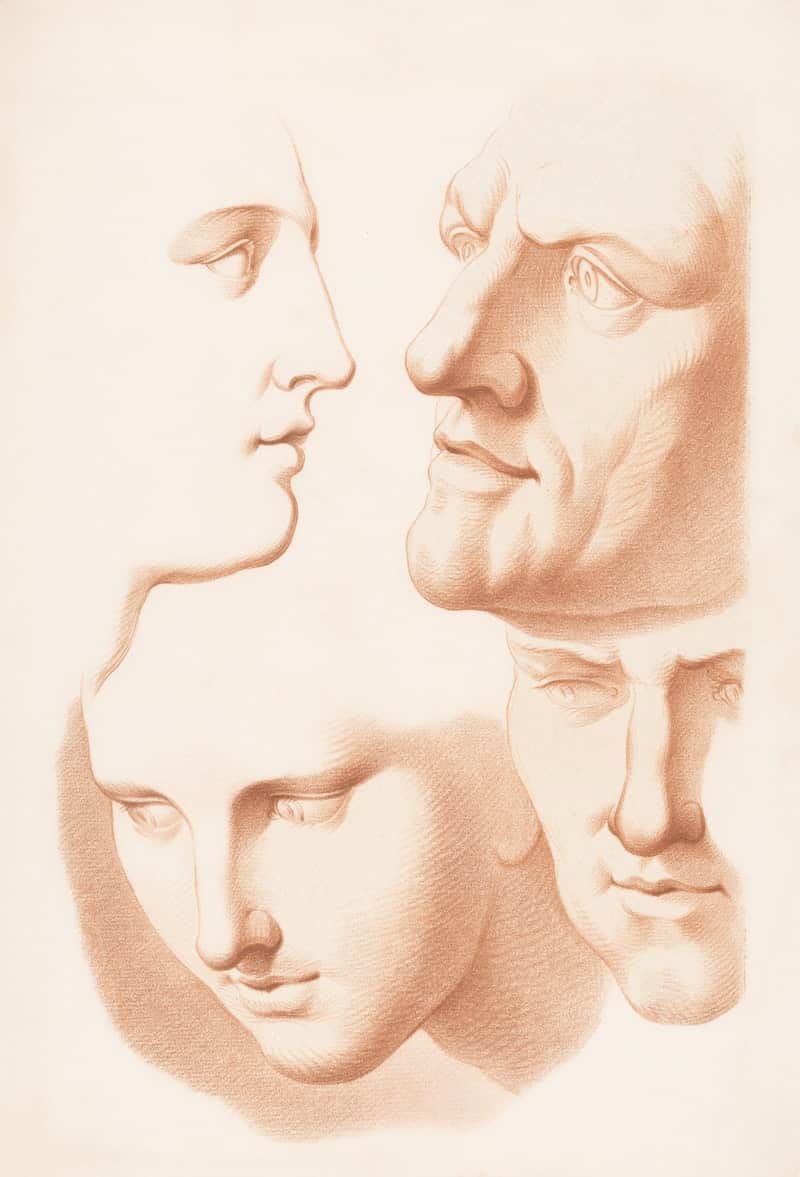
Input: A reference illustration in the style of a classical figure-drawing study: several red chalk sketches of a face and head shown from a front angle and a profile angle, similar to the head studies an art student would use to learn facial proportion.
- Facial symmetry78%
- Proportion to thirds71%
- Eye spacing balance82%
- Jaw to cheekbone ratio69%
- Overall harmony74%
Facial harmony readout
This sheet holds four head studies, so the read focuses on the front-facing young face at the lower left, the only one drawn straight on. Its proportions land close to the classic guidelines in a few areas and diverge in ways that give the face its own character.
- Vertical thirds: forehead, mid-face and lower face are close to even, with the lower third running slightly longer, which is common and reads as a defined chin rather than an imbalance.
- Eye spacing: the gap between the eyes is close to one eye-width, near the textbook fifths guideline.
- Symmetry: the downward tilt of the head makes the two halves read slightly differently, most visibly at the corners of the mouth. Mild asymmetry like this is normal; almost no face is a perfect mirror image.
- Jaw to cheekbone ratio: the jaw sits a little narrower than the cheekbones, giving a tapered, oval lower face.
Overall balance score: 74/100. Treat this as a description of proportion, not a statement about how attractive you are.
How it works
- 1
Upload a straight-on, well-lit photo
Face the camera directly with your head level and both ears roughly visible. Even, soft lighting from the front reduces shadows that can throw off symmetry readings, and a neutral expression gives the clearest baseline.
- 2
The model maps your key landmarks
It locates the outer corners of your eyes, the tip and base of your nose, the corners of your mouth, and your jaw and hairline, then estimates the distances and angles between them.
- 3
Those measurements are checked against classic proportion guides
The tool compares your landmarks to the horizontal thirds rule, the fifths rule for eye spacing, and rough golden-ratio relationships that show up often in facial proportion studies, without treating any single guideline as the final word.
- 4
You get scores and a written explanation
The result names which parts of your face are closely balanced and which are more asymmetric, and explains what drove each score instead of just handing you a number.
Use cases
Choosing a flattering haircut or beard length
Knowing whether your face reads as more angular or more rounded, and whether your jaw is wider or narrower than your cheekbones, gives a stylist or barber something concrete to work from.
Prepping for headshots or dating photos
The readout can point you toward the angle and lighting that plays to your most balanced features, rather than guessing at flattering poses.
Understanding makeup contouring
Contour and highlight techniques are built around adjusting perceived proportion. Seeing your actual measurements makes it easier to pick techniques that suit your face instead of a generic tutorial.
Satisfying curiosity about facial proportion
Some people simply want to see the numbers behind ideas like the golden ratio or the thirds rule applied to their own face, the way an art student studies proportion in a life-drawing class.
Tips for better results
- Use a photo with no filters, heavy makeup or angle distortion so the measurements reflect your actual face.
- Keep your head level and your chin neither tucked nor raised for the most accurate landmark mapping.
- Pull hair away from your forehead and ears so the tool can find your hairline and jaw edges.
- Run the test with two or three different photos if the scores vary a lot; lighting and angle both shift the numbers.
- Read the written explanation alongside the scores. The numbers alone don't capture expression, warmth or how a face moves.
Limitations
Attractiveness is subjective, shaped by culture, personal taste and context in ways no measurement can capture. This tool only scores geometric proportion and symmetry against classical guidelines; it says nothing about your actual worth or appeal, which depend on far more than face shape. Scores shift with camera angle, lens distortion, lighting and expression, so the same face can score differently in two photos taken minutes apart. The thirds, fifths and golden-ratio guidelines this tool references are historical rules of thumb from art and design, not scientific facts about beauty, and plenty of widely admired faces sit outside them. Treat the result as a proportion snapshot for your own interest, not as feedback to act on emotionally.
Frequently asked questions
Is this attractiveness test actually accurate?
It gives a reasonable visual estimate of how your features are spaced and how symmetrical they look, not a precise measurement. Attractiveness itself is subjective, so treat the score as a proportion snapshot rather than a verified fact.
Why did I get a different score on two different photos?
Camera angle, lens distance and lighting all shift where your landmarks appear to sit, so even the same face can produce noticeably different scores between shots.
What does a lower score actually mean?
It means your proportions diverge more from the classic thirds and fifths guidelines the tool checks against, not that you are less attractive; many striking faces have strong asymmetry.
Does facial symmetry equal attractiveness?
Symmetry is one factor researchers have studied, but expression, coloring, skin, personal style and context all play a large role that a static proportion check cannot capture.
Can I use this to plan a haircut or makeup routine?
Yes, the jaw-to-cheekbone and thirds readings are useful starting points for a stylist or contouring plan, even though the overall score itself isn't something to build decisions around.
Will the tool tell me I'm ugly?
No. The output describes proportion and balance in neutral terms and avoids passing judgment on how you look; it is built to inform, not to rate people harshly.
Plans start at $9 a month. See pricing