What the Math Problem Solver does
Point your camera at a math problem, whether it's handwritten on paper, printed in a textbook, or chalked on a board, and this tool reads it, figures out what kind of problem it is, and works through it one step at a time. It covers algebra, geometry, calculus, and more, showing the reasoning behind each step rather than dropping a bare answer. That makes it useful for checking your own work after you've tried a problem, for seeing exactly where a solution went sideways, or for understanding a method you haven't been taught in quite this way before. Every result ends with the final answer clearly marked and, where it's useful, a second method to verify it.
See a sample result
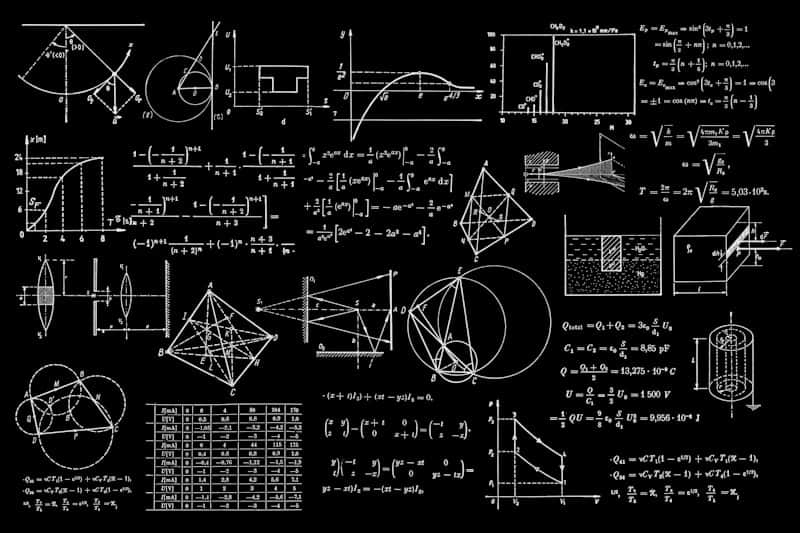
Input: A photo of a blackboard covered in chalk formulas and diagrams: triangles, circles, graphs, a pressure-volume cycle, and a cylindrical capacitor. There's no single question, so the details box said: 'Check the capacitor calculation in the middle right.' That block reads C1 = C2 = ε0·S/d1 = 8,85 pF, Q = 13,275·10⁻⁹ C, U = Q/C1 = (3/2)U0 = 1500 V, W = ½QU = 9,956·10⁻⁶ J.
1. Problem identification: Physics with algebra, an electrostatics problem on two identical capacitors sharing charge. The board uses decimal commas (8,85 means 8.85).
2. Step-by-step check: Each capacitance is C1 = ε0·S/d1 = 8.85 pF, so ε0·S/d1 = 8.85 × 10⁻¹² F. Total charge is 3·ε0·(S/d1)·U0. Since U = (3/2)U0 = 1500 V, U0 = 1000 V, and the total charge is 3 × 8.85 × 10⁻¹² × 1000 = 2.655 × 10⁻⁸ C. Split equally between the two capacitors: Q = 1.3275 × 10⁻⁸ C, which matches the board's 13,275·10⁻⁹ C. Voltage: U = Q / C1 = 1.3275 × 10⁻⁸ / 8.85 × 10⁻¹² = 1500 V. Matches. Energy: W = ½ × 1.3275 × 10⁻⁸ × 1500 = 9.956 × 10⁻⁶ J.
3. Final answer: U = 1500 V and W ≈ 9.96 × 10⁻⁶ J (about 10 μJ). The chalk work is consistent.
4. Verification: The closed form (9/8)·ε0·(S/d1)·U0² gives 9/8 × 8.85 × 10⁻¹² × 10⁶ = 9.956 × 10⁻⁶ J, the same result by a second route. The original question isn't on the board, so this confirms the arithmetic, not the setup.
How it works
- 1
Photograph the problem clearly
Get the full equation or question in frame, in focus, with even lighting. A blurry or partly cropped photo is the most common reason a symbol gets misread.
- 2
The tool identifies the type of problem
It sorts the problem into a category (algebra, geometry, calculus, trigonometry, and so on) since that determines which method and notation apply.
- 3
It's solved step by step
Each step is shown with a short explanation of what's being done and why, not just the next line of the calculation, so you can follow the logic rather than just the arithmetic.
- 4
You get the final answer and a check
The answer is stated clearly, and when it's practical, a second method or a plug-back verification is included so you can confirm the result independently.
Use cases
Checking homework before turning it in
Work the problem yourself first, then photograph it to compare your steps and answer against a full solution, so you catch mistakes before a teacher does.
Understanding a step you got stuck on
If you're stuck partway through a problem, a step-by-step solution shows the specific move you were missing, not just the destination.
Reviewing for a test
Photograph practice problems from a review sheet or old test and work through solutions to spot the topics you need to revisit.
Helping with a kid's homework you're rusty on
If it's been years since you've done geometry or algebra, a clear step-by-step breakdown can refresh the method faster than searching for it.
Working through a textbook problem with no answer key
Some workbooks and worksheets don't include full solutions. This gives you a way to check a method rather than just guessing whether your answer is right.
Tips for better results
- Fill the frame with just the one problem you want solved; a photo with several problems crowded together increases the chance of the wrong one being read.
- Photograph straight-on rather than at an angle, since a skewed shot can make exponents, subscripts, and fraction bars harder to tell apart.
- Good, even lighting matters more than a high-end camera; a shadow across half the page is a common cause of misread digits.
- If your handwriting is hard to read even to you, rewrite the problem clearly before photographing it rather than relying on the tool to guess intent.
- Always work through the steps yourself rather than copying the final answer straight down; the point of a step-by-step solution is to understand the method, and checking it against your own reasoning is how mistakes actually get caught.
- On a busy page, use the details box to say which problem you mean ('number 4b' or 'the one in the box'), or what you want: a full solution, a hint, or a check of your work.
Frequently asked questions
What kinds of math problems can it solve?
Algebra, geometry, trigonometry, calculus, and general arithmetic word problems are all within scope. Complex, multi-page proofs or highly specialized notation are harder to read reliably from a single photo.
Does it show the steps or just the final answer?
It shows the full working, step by step, with a short explanation at each stage, then states the final answer clearly at the end.
Can it read handwritten problems?
Yes, as long as the handwriting is reasonably clear and the photo is in focus. Messy handwriting, especially with ambiguous symbols like a 1 that looks like a 7, is the most common source of a misread problem.
Is the answer always correct?
The tool works through the math carefully and verifies where practical, but it can still misread a symbol from the photo or make an error, like any solver can. Treat the result as a worked solution to check your own reasoning against, not a guaranteed-correct answer key, and recheck any step that looks off.
Can I use this to complete an exam or a timed quiz?
It's built for practice, review, and checking your own work outside of testing conditions. Using it during a proctored exam or quiz would likely violate your school's academic rules, so check those before relying on it in a graded setting.
What if the problem in my photo gets misread?
Retake the photo with better lighting and a straighter angle, and make sure only one problem is in frame. If your handwriting is ambiguous in places, rewriting the problem clearly usually fixes it.
Does it handle word problems, not just equations?
Yes, it can read a written word problem and set up the equation itself as the first step, then solve from there, showing how it translated the words into math.
Plans start at $9 a month. See pricing