Coffee Reading
Upload a photo of your finished coffee cup and get a tasseography-style reading of the patterns left behind.
What the Coffee Reader does
Finishing a cup of Turkish or Greek coffee and flipping it over to see what the grounds left behind is a tradition that goes back generations, usually shared over conversation rather than taken as fact. This tool joins in on that: photograph the grounds settled in your cup or saucer, and it reads the shapes the way a tasseography practitioner would, naming what it sees (a bird, a ring, a winding path) and offering the traditional meaning attached to each. It's built for fun and for keeping a cultural custom alive digitally, not for telling you what's actually going to happen. Treat the reading as a conversation starter, the same way you would with a friend who claims to know tasseography.
See a sample result
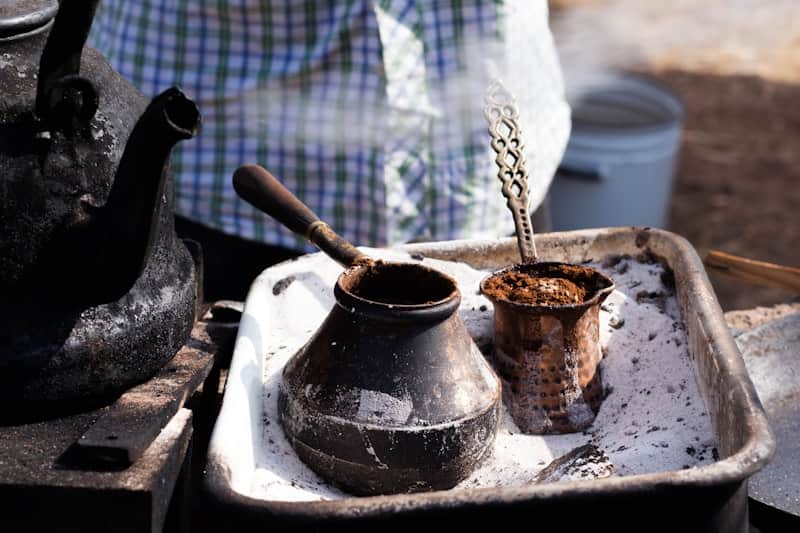
Input: A phone photo looking into a small white Turkish coffee cup that was turned upside down on its saucer and left to cool. Dried grounds coat the inside walls: a large curved clump near the rim on the handle side, a thin line running down toward the bottom, and a round, lighter ring near the base (the image at the top of this page, coffee brewing in hot sand, is an illustration).
- Symbol Clarity62%
- Home & Family55%
- Travel & Journeys48%
- Love & Relationships35%
Reading for entertainment only
The rim (the near future): The large curved clump near the rim on the handle side has the outline of a bird with open wings. In tasseography a bird is read as news on its way, and near the handle it's said to concern home or someone close to you.
The walls (the path): A thin line runs from that clump down toward the bottom. Readers traditionally see a line as a journey or a decision in motion; a clean, unbroken one like this is read as a smooth path rather than a detour.
The base (what's settled): The lighter ring near the bottom is a classic symbol of completion or commitment, something coming full circle.
Put together: A light, hopeful cup: news from home, a plan moving forward, and something that gets finished. The grounds on the far wall are thin and patchy, so there's little to read there.
Tip: Leave just a sip of coffee over the grounds before you flip the cup. Too much liquid washes the shapes into a smear.
How it works
- 1
Drink your coffee unfiltered, Turkish or Greek style
The grounds need to settle at the bottom for a reading to work. Swirl the cup gently and let a thin layer of grounds coat the inside walls.
- 2
Photograph the grounds clearly
Whether you invert the cup onto a saucer or shoot straight down into the cup itself, get close enough that the texture and clumps of grounds are visible.
- 3
The AI looks for shapes and symbols
It scans the patterns for recognizable forms, like animals, letters, or lines, that tasseography traditionally assigns meaning to.
- 4
Get a written reading for entertainment
You receive a playful interpretation of what the shapes traditionally represent, framed as a fun cultural exercise rather than a forecast.
Use cases
Keeping a family or cultural tradition going
Someone who grew up watching a grandmother read coffee cups wants a way to keep the custom alive when there's no one around who remembers how.
A fun activity after dinner with friends
A group finishing Turkish or Greek coffee together passes a phone around, each person getting their own lighthearted reading of their cup.
Learning what different symbols traditionally mean
Someone curious about tasseography uses the readings to pick up the traditional meanings behind shapes like rings, birds, or hearts.
A conversation piece for a coffee-themed event
Cafes or hosts use it as a novelty activity for guests, turning the end of a coffee service into something interactive.
Tips for better results
- Use finely ground, unfiltered coffee (Turkish or Greek style); drip or filtered coffee won't leave a readable pattern.
- Let the cup sit inverted on its saucer for a few minutes so the grounds set before you photograph them.
- Shoot in good light with the camera close to the cup so individual clumps and lines are visible, not just a dark smear.
- Try both the cup's interior and the saucer if grounds transferred there; different surfaces sometimes show different shapes.
- Add a question in the details box, like 'anything about travel,' and the reading will focus on symbols tied to that theme.
Limitations
This is entertainment rooted in a real cultural tradition, not a prediction of future events. The AI is matching grounds patterns to symbols the way a person practicing tasseography would, which is a subjective, visual exercise, not a measurement of anything. Don't use a reading to make real decisions about relationships, money, health, or travel.
Frequently asked questions
Is coffee reading actually able to predict the future?
No, this is a cultural tradition presented for entertainment. The AI describes shapes in the grounds and their traditional tasseography meanings; it isn't forecasting real events.
Does it work with regular drip coffee grounds?
Not well. Tasseography relies on the fine, unfiltered grounds from Turkish or Greek style coffee that coat the cup; drip coffee grounds are too coarse and get filtered out before drinking.
Should I photograph the cup or the saucer?
Either can work if grounds transferred there. The classic method inverts the cup onto the saucer, but a clear photo of the grounds still inside the cup works too.
What do the different shapes mean?
The reading explains each shape it identifies in traditional tasseography terms, like a bird for news or a ring for commitment, alongside the reasoning for that read.
Can I ask about a specific topic, like love or career?
Yes, mention it in the details box and the reading will lean toward symbols and themes tied to that topic.
Why did my reading come back vague or unclear?
Grounds that are too thin, too wet, or unevenly distributed leave fewer distinct shapes to work with, so the reading should say the cup is hard to read. If it still describes lots of shapes, try a sharper photo, since the AI can see shapes in noise the way people see faces in clouds.
Plans start at $9 a month. See pricing