Location Identifier
Upload a photo and get a reasoned guess at where in the world it was taken.
What the Location Identifier does
Somewhere in your camera roll is a photo you can't place anymore. A well-traveled friend would start with the details, and so does this location identifier: the shape of the buildings, the language on a sign, the plants in the background, the color of the soil, the style of the road markings. From those clues it puts together a guess at the country, region, or city, and explains which details led there. It's built for travel photos, landmark shots, and old vacation pictures you want to place, not for pinpointing where a private, unidentified photo of a person was taken. Send in a photo and get back a best guess, a confidence level, and the reasoning behind it.
See a sample result
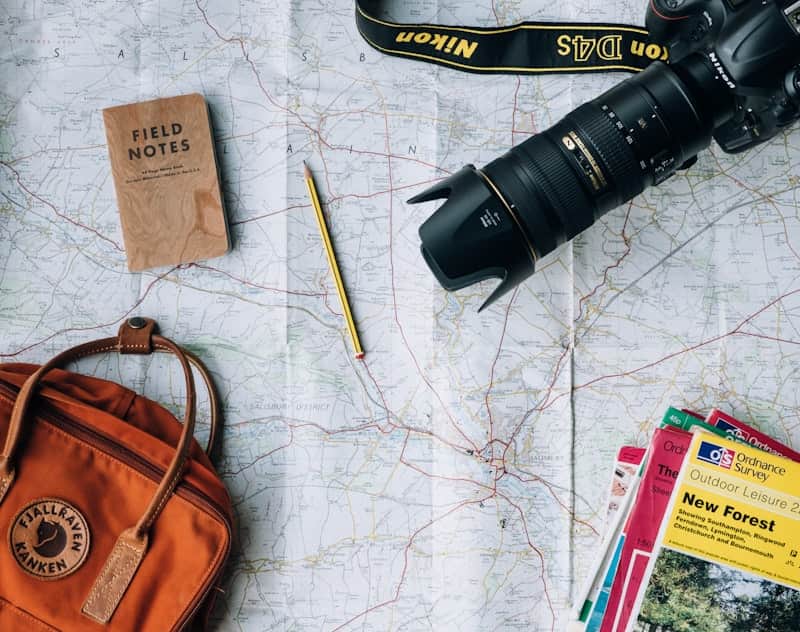
Input: An overhead flat-lay photo of travel gear on top of a paper road map: a Nikon camera with a long lens, a small notebook labeled 'Field Notes,' a pencil, an orange backpack, and the corner of an Ordnance Survey leisure map booklet reading 'New Forest.'
- New Forest, England74%
- Elsewhere in southern England18%
- Elsewhere in the United Kingdom8%
Likely location: New Forest, Hampshire, England
The strongest clue here isn't the landscape, it's the map itself. The visible booklet is an Ordnance Survey Outdoor Leisure map, a series specific to Great Britain, and the printed title names the New Forest, a national park in southern England known for heathland and free-roaming ponies.
Supporting details: the road map style, junction numbering, and place-name formatting are consistent with a UK Ordnance Survey product rather than a US, Canadian, or European road atlas. The gear itself (a Nikon DSLR, a canvas backpack, a small field notebook) doesn't point to a specific place on its own, but it fits the pattern of someone planning a walking or wildlife trip in that region.
Confidence: high on the country and region, since the map title is directly legible. Exact town within the New Forest can't be determined from this photo alone.
How it works
- 1
Upload a photo with visible context
A shot that includes some background, not just a tight close-up, gives the tool something to work with: buildings, signage, vegetation, or landscape.
- 2
The tool scans for regional clues
It looks at architecture style, written language on signs, vehicle types, plant life, terrain, and light quality, the same categories a geography enthusiast would check first.
- 3
Clues get weighed against each other
A palm tree alone means little, but paired with a specific road sign style or building material, the possible locations narrow fast.
- 4
You get a guess with reasoning
The result names a likely country, region, or city, states how confident that guess is, and lists the specific visual details that pointed there.
Use cases
Placing an old travel photo
You have a photo from a trip years ago and can't remember which town or country it was taken in. Upload it and get a starting guess based on what's visible.
Identifying a landmark you don't recognize
A photo shows an unfamiliar building, statue, or bridge. The tool can suggest what it is and where it's likely located based on its style and setting.
Planning a trip around a photo you saved
If you saved a scenic photo without knowing where it was taken, this gives you a region to start researching before you book anything.
Geography games and quizzes with friends
Upload photos to test how well the tool (or you) can guess the location, similar to popular location-guessing games, using your own travel photos instead of a fixed set.
Tips for better results
- Include some background in the shot rather than a tight crop; empty sky or a blank wall gives the tool almost nothing to work with.
- Photos with visible text, signage, license plates, or printed material (like a map or menu) tend to produce much more confident guesses.
- Architecture and building materials are strong clues; a single plant or animal usually isn't, since many species and plants exist across several regions.
- If the first guess feels off, try a second photo from the same location with a different angle or a different visible detail.
- This tool is meant for landmarks, travel scenes, and vacation photos. Don't use it to try to figure out where a private individual lives or was photographed without their knowledge; that's not what it's for and the guesses aren't reliable enough to act on anyway.
Limitations
A location guess from a photo is exactly that, a guess built from visual pattern matching, not a verified fact. Many places around the world share similar architecture, plants, and terrain, and a photo with few distinguishing details (a plain room, a generic street, a close-up of a person or object) will produce a low-confidence result or a wrong one. Treat the output as a lead worth checking, not a confirmed answer, especially for anything that matters.
Frequently asked questions
How accurate is a photo location guess?
It varies a lot with the photo. A shot with a recognizable landmark, visible text, or distinctive architecture can produce a confident and often correct guess. A photo of a generic room, close-up subject, or common landscape gives the tool little to go on and the guess should be treated as a rough starting point.
Can this identify exactly where I am right now?
It works from an uploaded photo's visual content only. It doesn't use GPS data, real-time location, or any information beyond what's visible in the image, so it can't tell you your current position, only what a photo's contents suggest about where it was taken.
Is this meant for finding out where a person lives?
No. This tool is built for travel photos and landmarks, places, not people. It isn't a reliable or appropriate way to try to locate or track a specific individual, and the guesses aren't precise enough to be used that way even if someone tried.
Does it work on indoor photos?
Indoor photos are harder, since rooms tend to look similar worldwide unless there's a visible sign, outlet style, language on packaging, or view through a window.
Can it identify a specific landmark by name?
Yes, if the landmark is visually distinctive or well known, the tool will often name it directly along with the region or country it's located in.
Why did it guess the wrong country?
Some regions share very similar building styles, plants, and terrain, especially across neighboring countries. Adding a photo with clearer text or a more distinctive structure usually improves the guess.
Does it store or share the photos I upload?
The tool analyzes the photo you upload to produce the result you see. It isn't a location-sharing or social feature, and results aren't published anywhere.
Plans start at $9 a month. See pricing