What the Language Identifier does
Maybe it's a street sign from a trip, a label on a package, or a page from an old book you found in a box. You can read the letters fine, but you have no idea what language you're looking at. The language identifier reads the text in your photo and works out which language it most likely is, what alphabet or script it uses, and whether more than one language appears on the same page. Upload a clear picture, add a note in the details box if you already have a guess, and you get a written breakdown with scores for the languages it considered.
See a sample result
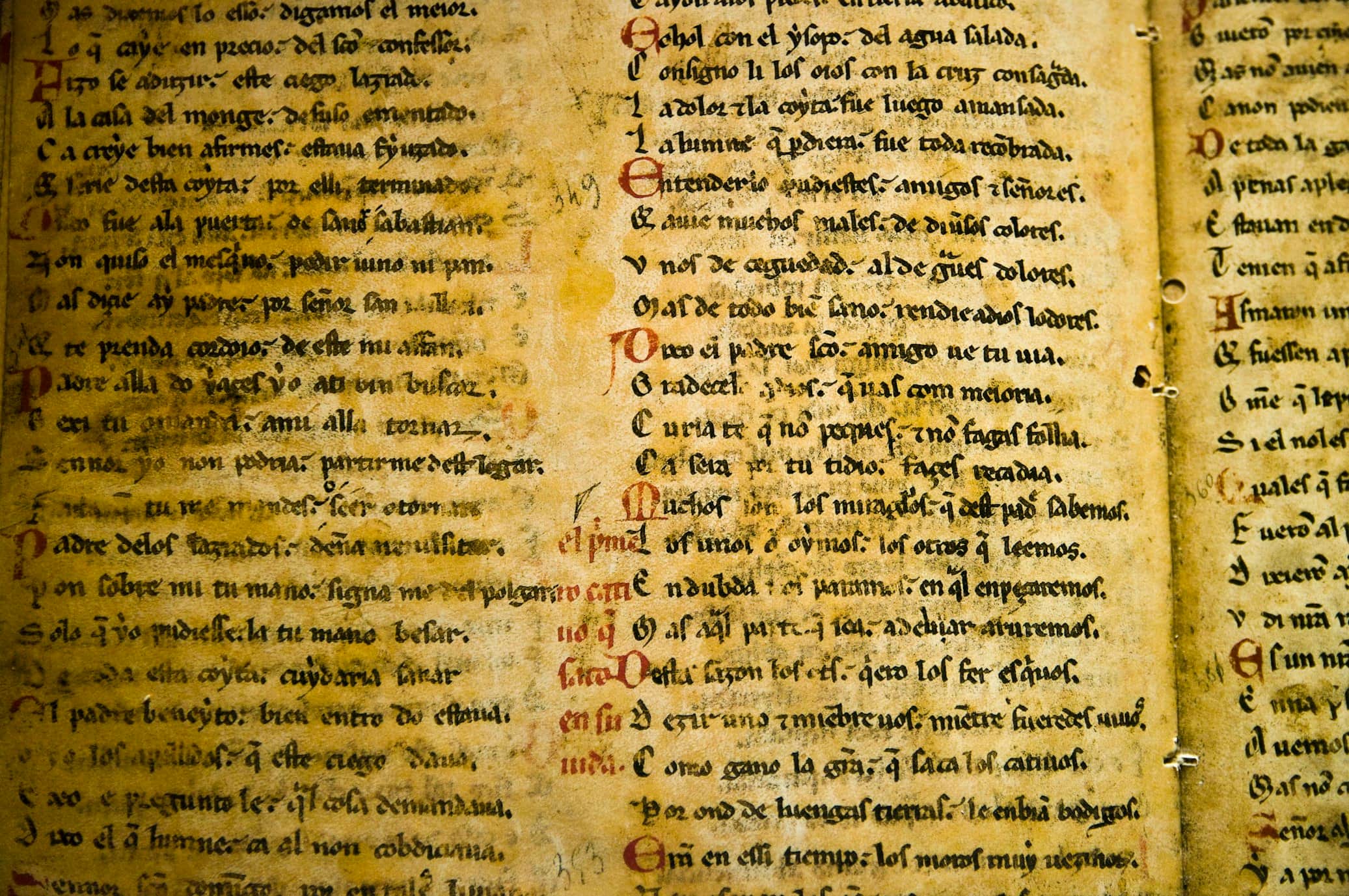
Input: A close-up photo of an open medieval manuscript: columns of gothic book hand in dark brown ink on stained, yellowed parchment, with red initials at the start of some lines and a few red words in the margin. Phrases like "con el ysopo del agua salada" and "amigos e señores" are legible.
- Old Spanish (Castilian)84%
- Old Leonese8%
- Galician-Portuguese5%
- Medieval Latin3%
Language: Old Spanish (Castilian), likely 13th to 14th century
Writing system: Latin alphabet in a gothic cursive book hand, with red rubricated initials marking verse or stanza breaks. Letterforms show heavy abbreviation marks common to medieval scribal copying.
Notes: Readable phrases such as "con el ysopo del agua salada", "amigos e señores" and "Muchos son los miragros" use early Castilian spellings ("miragros" for modern "milagros", "e" for "y"). The lines fall into four-line groups that share one rhyme (señores, colores, dolores, loores), the cuaderna vía verse form used by 13th-century Castilian clerical poets. Words like "monge" and "miragros" point to a devotional text about saints' miracles.
Why not Latin or Portuguese: Articles like "el" and "los" and forms like "señores" rule out Latin, and Portuguese of the period would write "senhores" and "os".
Confidence: High for the language, lower for the exact date and regional variety, since the faded left column and abbreviation marks hide some words.
How it works
- 1
Photograph the text straight on
Fill the frame with the words and keep the camera level so letters aren't stretched or curved. Menus, signs, book pages, and handwritten notes all work.
- 2
Add context if you have it
Use the details box to mention where the photo was taken or what you suspect the language is. That context helps the model narrow down close relatives like Portuguese and Spanish.
- 3
The model reads the script and wording
It looks at the alphabet, common letter combinations, accents and diacritics, and recognizable words or grammar patterns to judge which language fits best.
- 4
Get a ranked result
You get the most likely language along with runner-up guesses and a score for each, plus notes on the writing system and any regional spelling it noticed.
Use cases
Travel photos of signs and menus
You snapped a photo of a menu or road sign abroad and want to know the language before you try to translate it or ask a local.
Old letters and family documents
A relative's handwritten letter or a document from an estate is in a language nobody in the family recognizes anymore.
Packaging and product labels
You bought something online or while traveling and the label has no language you recognize, just instructions or ingredients in an unfamiliar script.
Research and translation prep
Before running text through a translator, you want to confirm the source language, especially with scripts that look similar, like Cyrillic-based languages.
Old books, postcards, and manuscripts
You've got a page of antique or handwritten text and want a starting point on what language and era it might be from before doing further research.
Tips for better results
- Photograph in good, even light so faint ink or worn print stays legible.
- Include a full sentence or paragraph rather than a single word; more text means a more reliable read.
- Avoid glare on glossy pages by angling the camera slightly instead of shooting straight down.
- If a page has more than one language, mention that in the details box so the model separates them instead of averaging a guess.
- For handwriting, a sharper macro shot of a few lines beats a wide shot of a whole page.
Frequently asked questions
Can it identify handwritten text, not just printed text?
Yes, though handwriting is harder to read than print. Clear, well-lit photos of cursive or print handwriting usually work; heavily stylized or very faded handwriting lowers confidence.
What if the photo has two languages on it?
The model will try to call out both and note where each appears, for example a label with instructions in one language and a warning in another. Mention it in the details box if you already know this.
Does it translate the text too?
This tool focuses on identifying the language and script, not full translation. If you need the wording translated, the translate-image tool is built for that.
How accurate is the language guess?
It's a visual and linguistic estimate, not a certified analysis. Closely related languages that share an alphabet, like Spanish, Portuguese, and Italian, can be mixed up, especially with short or blurry text.
Can it recognize non-Latin scripts like Arabic, Cyrillic, or Chinese characters?
Yes, it can identify a range of scripts and note which one it sees, along with the language it most likely represents within that script.
Will it identify a dialect or regional variation?
Sometimes. If the wording or spelling shows clear regional markers, the result will mention them, but dialect calls are less certain than the main language identification.
Can it help with genealogy research on old family documents?
Yes, a lot of people use it as a first step on immigration papers, letters, or church records written in a language they no longer read, before handing the document to a translator or archivist.
Does each upload use a credit?
Yes, each analysis run costs a credit from your account, the same as the site's other analysis tools.
Plans start at $9 a month. See pricing